
BARNACLES on FISTRAL
Does Barnacle distribution change in relation to height on the rocky shore?


Zones are bands that have a characteristic group of organisms in them and are arranged vertically on the shore from the sea to the land. (Stephenson & Stephenson, 1949).
Barnacles typically mark the top of the littoral zone at the mean high water of the spring tide mark and they can be found down to just below mean low water of the spring tide mark (Lewis, 1964). Community structure on the rocky shore shows direct response to abiotic factors. For example the higher up the shore an organism is the more it will be subject to time out of the water which may cause organisms to dry out. Other factors include exposure or wave action, different organisms have different adaptions to cope with exposure. Barnacles adapt by being stuck on and are sessile for most of their life. Factors that limit upper ranges of organisms tend to be abiotic. Biotic interactions include larval dispersal, predation, grazing and resource competition. Biotic factors are often limiting factors for the bottom of the barnacles limit.
Some species may encourage the presence of another species and some will inhibit them (UK Marine SAC's Project, 2001). On Fistral it was hard to identity between Cthamalus spp. And S balanoides, however the Marine Life Information Network shows the distribution of S balanoides to be more limited than Chthamalus spp. in the Southwest (Marine Life Information Network, No date). The majority of barnacles on the transect were C stellatus but there were some C montagui and S balanoides (Figure 7) identification was difficult and help was sought from A Jackson.

Figure 7 Chthamalus spp. and S balanoides. (10419926b, 2015)
Barnacles are limited to their zones for a variety of reasons. Temperature is a major factor in distribution of barnacles. S balanoides thrives in a colder water and is often found in higher densities on low to mid littoral zones whereas C stellatus and C montagui prefer warmer water and are often found in higher densities in the top part of the littoral zone (Connel, 1972). Chthamalus spp. and S balanoides are found in some parts of the Southwest although their density has changed over time. In periods dominated by warmer weather Chthamalus Spp. have increased and when colder periods have persisted S balanoides have dominated (Southward , et al., 1995).
Fistral had a larger density of barnacles than fucoids and this may suggest that Fistral is quite exposed to wave action (Ballantine, W., J., (1961) cited by Field Studies Coucil,
(2008). When shores are sheltered, mid zones are dominated by fucoids and when shores are exposed, barnacles and mussels dominate. Other species interactions can affect the density of barnacles (Hawkins, et al., 1983) especially when shores have medium exposure. Hawkins et al (1983) suggests limpets, dog whelks and the fucoid bladder wrack can have an effect on barnacle density via a cycle of different stages outlined below. These shores are composed of a mosaic of patches of species which come and go over a three or four year cycle. Limpets are grazers of young bladder wrack but when mature, bladder wrack fronds can dislodge barnacles. Juvenile limpets can also knock off newly settled barnacles. Dog whelks predate barnacles and use the bladder wrack fronds for refuge. However the sweeping fronds and limpets also minimise juvenile bladder wrack from colonising. After a period of time the old bladder wracks die and are no longer replaced, the limpets also then decrease. Bare rock is next colonised by barnacles and the cycle starts again.
When examining the abundance of limpets, fucoids and barnacles on Fistral there are dominant patches of both limpet’s fucoids and barnacles. The fucoid and barnacle distribution are marked in different patches and the two are not seen to overlap to any great degree (Figure 8)

Figure 8 Distinct patches of barnacles and fucoids (10419926c, 2015).
Barnacles are an important part of the trophic structure of rocky shores. They are important organisms as they move nutrients from particulate organic matter and phytoplankton that they filter feed on up the trophic levels. The barnacles are then predated by some fish and dog whelks (Figure 9) that are in turn predated by higher level predators. (UK Marine SAC's Project, 2001)

Figure 9 Dog whelk predating barnacles (10419926d, 2015).
Barnacles have an important role to play in rocky shore communities as they help cycle energy through the food web (Figure 10). This is important for all organisms in the commumity. Barnacles play a part in sustaining a system which grows food for human communities so it is vital that the system is taken care of as a whole.
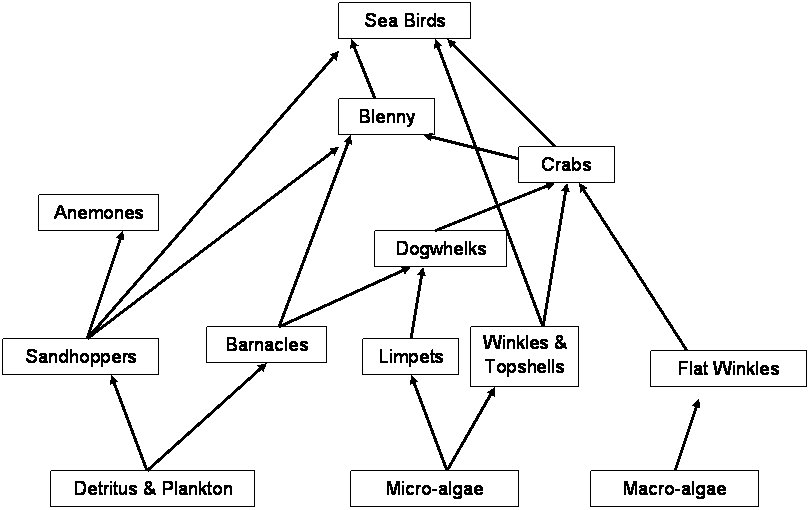
10 Generalised food web for the rocky shore. (Field Studies Council, 2008)
This study shows that barnacles have been monitored extensively and are also good bio indicators to the effects of climate change.
Barnacles may seem small and insignificant to the casual observer but hopefully this study shows how important and interesting they are.

Student ID 10419926